Share

Thursday, 26 June 2014

GROOOOOVY BABY!

Wellhill has been a hive of activity all day. First thing this morning Becca started the excavation of a small pit that looked choc-a-block full of charcoal. Once scrape later and we found out it was also full of Grooved Ware! This sort of pottery is associated with the late Neolithic (c. 4000 years ago) so we now think we have a series of late Neolithic features as well as some evidence for early Bronze Age activity.

Right on cue the students started finding sherds of Bronze Age pottery from the upper fills of the large circular pits. These respect the ardmarks we have interpreted as being part of a Bronze Age field system. The ardmarks also cut some of the features which we now think are likely to be late Neolithic.

We found more pottery today than we have over the whole of many of the previous seasons, hopefully lots more to follow as we get stuck into the features over the next couple of weeks. Thanks to all the students who have put in a load of hard work this week and particularly to Becca who found loads of pottery but more importantly brought us cake. No digging tomorrow as we are all having a well deserved rest after a week of exciting discoveries.


                                                               Becca 'potluck' Younger

Wednesday, 25 June 2014

Has anyone seen this man? He was last seen eating a jar of pickled eggs and a macaroni cheese pie with lashings of hot sauce.............


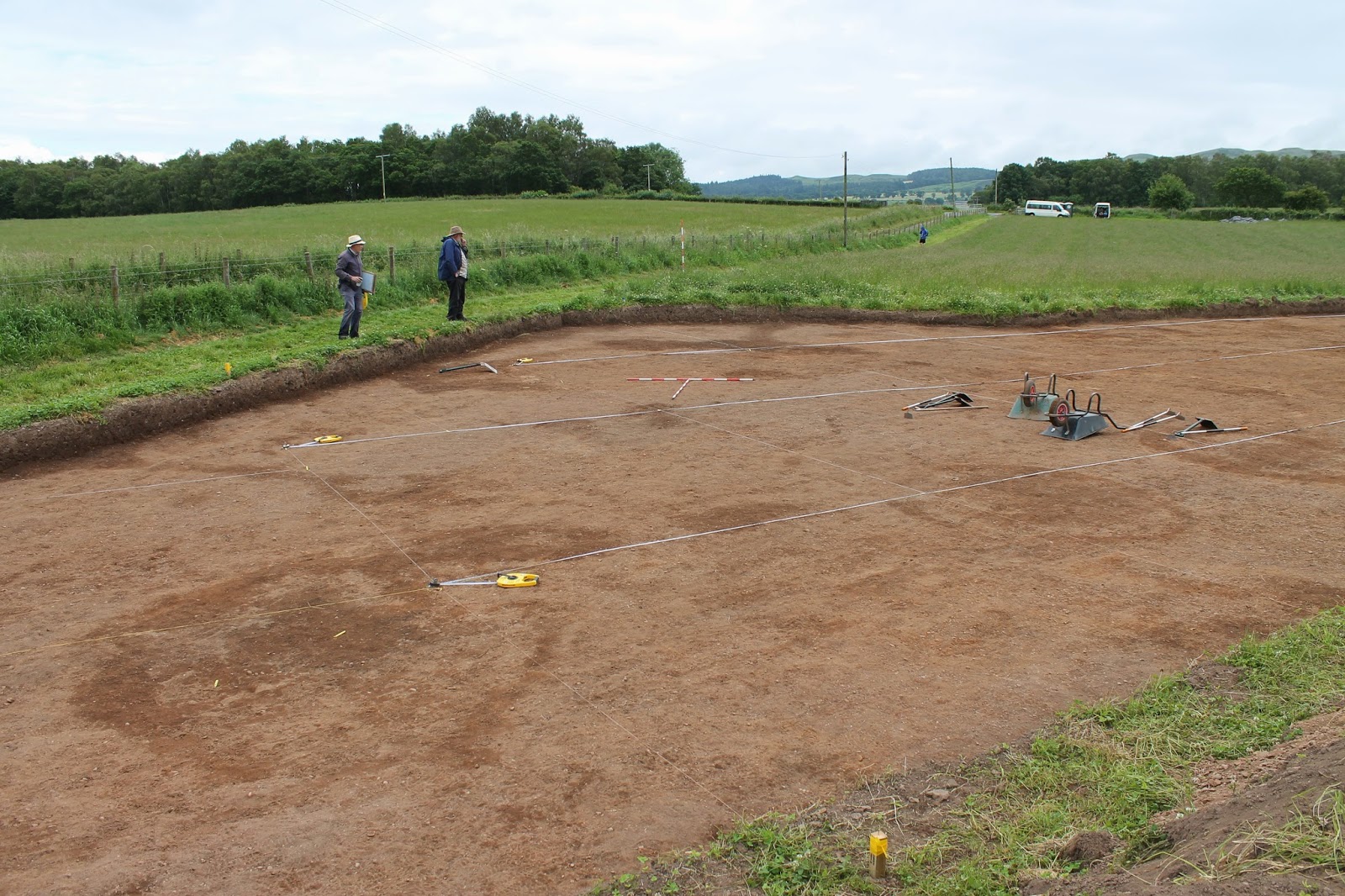
Work continues at Wellhill. We have been planning for the last two days, mapping out the features in the trench which is not as straightforward as it could be due to some dry weather. Here is what the trench looks like most of the time:

We then clean the trench and start to draw the edges of the features:


Every now and then there are tiny glimpses of where the features are, particularly after a wee shower of rain where the features suddenly pop out: 


The circular features you can see in these photos are some of the nine massive pits we have in the trench. The larger ones are up to 5-6m in diameter and they seem to be drying out with a band or ring surrounding a smaller darker blob in the middle. The planning is finishing up now so we will be getting into feature digging tomorrow. Stay posted!


Monday, 23 June 2014

We found a really big worm today! In other news the students at Wellhill learned how to set out the site grid in Trench 1 and 2 and we planned the features in Trench 2. Planning in Trench 1 will start tomorrow.

Sunday, 22 June 2014

Hello from the SERF Fieldschool 2014. Staff and students from Glasgow University, Phil from Liverpool Uni and some overseas visitors arrived on site on Saturday to begin another season of work. The sites being dug this year include a prehistoric cropmark complex at Wellhill, a Roman temporary camp in Kincladdie Wood and near Pitcairns House and a prehistoric barrow at Millhaugh. This year we also have Katy Firth from Northlight Heritage running some community excavations in the village of Dunning, walkover survey near Coul and topographic and geophysical at several sites.

Over the last few days we have all been at Wellhill cleaning three large trenches to show up the features. So far we have lots of pits, postholes, and a probable Bronze Age field system with the remains of ardmarks visible. In a completely unprecedented move we found some prehistoric and probably Bronze Age pottery on the first day. Much excitement!

Joss, Phil and Steve have been opening up the Roman temporary camp at Kincladdie and the barrow will be started on Monday.

Keep posted over the next three weeks for more updates.


Tuesday, 22 April 2014

Last Days and the End of Castle Law Excavations 2014

Castle Law excavations 2014 is now over.  The final days were very busy and therefore the blog went silent, but here is a picture recap of the last days of the dig and the ultimate destruction of the backfilling team.

I would like to thank everyone that helped on site - it was extreme archaeology that only could be done be an extreme team!  Thank you all!  I would also like to thank the Dupplin Estate and Michael Blanche of Culteuchar farm for letting us carry out our crazy dig. - TP

Sondage through stone 'capping' of bank and leveled area over burnt deposits of earlier bank in Trench F
Alan recording sondage in Trench F
Odd hearth stone on slope in Trench F
Rough cobble surface of hut platform in Trench F
Effie Photos-Jones came along and zapped the area of soil vitrification in Trench E for chemical composition analyses
Neil's sondage through the vitrified bank material on to a layer of black ash and charcoal
Section of vitrified bank on the vestiges of an earlier bank
A rock cut ditch was discovered filled with large boulders at the base of the bank (who knew??)
More sampling for post-excavation analyses
The wall of the inner enclosure through the rubble in Trench G
Look at that rubble and collapse... very sexy!!
Veronika, Alistair and Ian very happy to reach bedrock through the rubble and clay!!
Dream Team's hole through the core of the wall (check out the drips and stains of vitrification in the top right of the section - magic!!!)
Another fantastic picture of the Dream Team (others had to be censored!!!)
Finished returfing Trench G on the last day - look at the beautiful sunshine!
An amazing but exhausted team at the end of backfilling!!! - Thank you all

Friday, 18 April 2014

Surveying with RCAHMS at Law of Dumbuils


This week I have been following in Yvonne’s footsteps and learning about plane table drawing from the RCAHMS surveyors, Ian, George, and John at Law of Dumbuils hillfort.

When we first visited the site, George suggested I spend half an hour making a quick sketch of how the structure of the fort appeared to me. It was a little overwhelming at first as the fort is made up of multiple ramparts and full of lumps and bumps.

At first it was difficult to disentangle all of the features at Law of Dumbuils


The Wild (“Veelt”) RK1 alidade is the workhorse of RCAHMS surveys – no longer made and older than George!

When surveying, RCAHMS use a mix of traditional and hi-tech methods, from plane-table surveying to differential GPS surveying. This gives them a full and balanced understanding of a site. The primary tool used is a self-reducing alidade, typically with a 1:500 scale. Ian, a draughtsman with 40 years experience, explained that this scale removes a degree of subjectivity and any small errors that may occur when recording.  After Ian had explained to me how the alidade works, I started to record some of the fort’s features with the help of John. By the end of the day the plan was starting to take shape!

Familiarising myself with the alidade.


Final day of Fieldwalking


Day 4 and all done by 2.30pm. Fewer finds in Field 2 on Thursday, although we managed to bag 35 artefacts (179 in total). A very successful four days. Special thanks to the fieldwalking team, Calum Rollo (landowner), John Neil (farmer) and our visitors Kenny & Jan Brophy.

Dene

Thursday, 17 April 2014

Further Fieldwalking Tales


Another successful day (16/7) fieldwalking at Millhaugh. Bagged finds now up to 144. I'm pleased to say that the vast majority are chipped stone. Many thanks to an exceptional team, namely Sophie Bojadziev, Gillian Bond, Daniel Maclean, Patricia Neuhoff and Katherine Price, and not forgetting Alex Alexander who was with us for the first two days.

We had visits from Calum Rollo (landowner) and Kenny & Jan Brophy. Jan very kindly brought us homemade Cypriot almond biscuits. Delicious and all gone :)

Dene

Wednesday, 16 April 2014

Millhaugh Fieldwalking

Other activities going on by the SERF project this week include fieldwalking (headed up by Dene Wright)


"Very successful first two days with more than 60 pieces of worked flint and jasper including flint cores and scrapers. There's other stuff but it's not as exciting as the chipped stone :) Thanks to Alex, Gillian, Katherine, Sophie and Patricia." - Dene